Keyword research — the foundation under every serious SEO project
"What keywords should I actually write about?" — that is the first question every business owner asks me. The answer is not a list, it is a map. Which terms Israelis type into Google when they are looking for your product, which of those you can realistically compete for, and in what order to write the content. What you get from me: a Google Sheet with 200-500 terms classified by intent, search volume, and KD, plus a visual cluster map. One-time deliverable, ₪1,800 + VAT.
Why keyword research has to come before any article gets written
- ✓ Writing a blog without keyword research is guessing. Most of those articles target phrases nobody searches, or phrases too competitive for you right now. Both mistakes cost the same — months of writing that fails to rank
- ✓ Someone searching "how to X" wants an article. Someone searching "X price" wants a service page. Someone searching "buy X" wants a product page. If the phrase is classified wrong against intent, Google is unlikely to rank your page even if the writing is excellent — it is the wrong page type for the query
- ✓ A hierarchical map of topical clusters lets you cover a niche in depth instead of with one random article, which helps readers and Google understand what your site is about
- ✓ A prioritized writing plan saves months. You write first the phrases most likely to bring clicks soon, not the phrase that is the most fun to write about
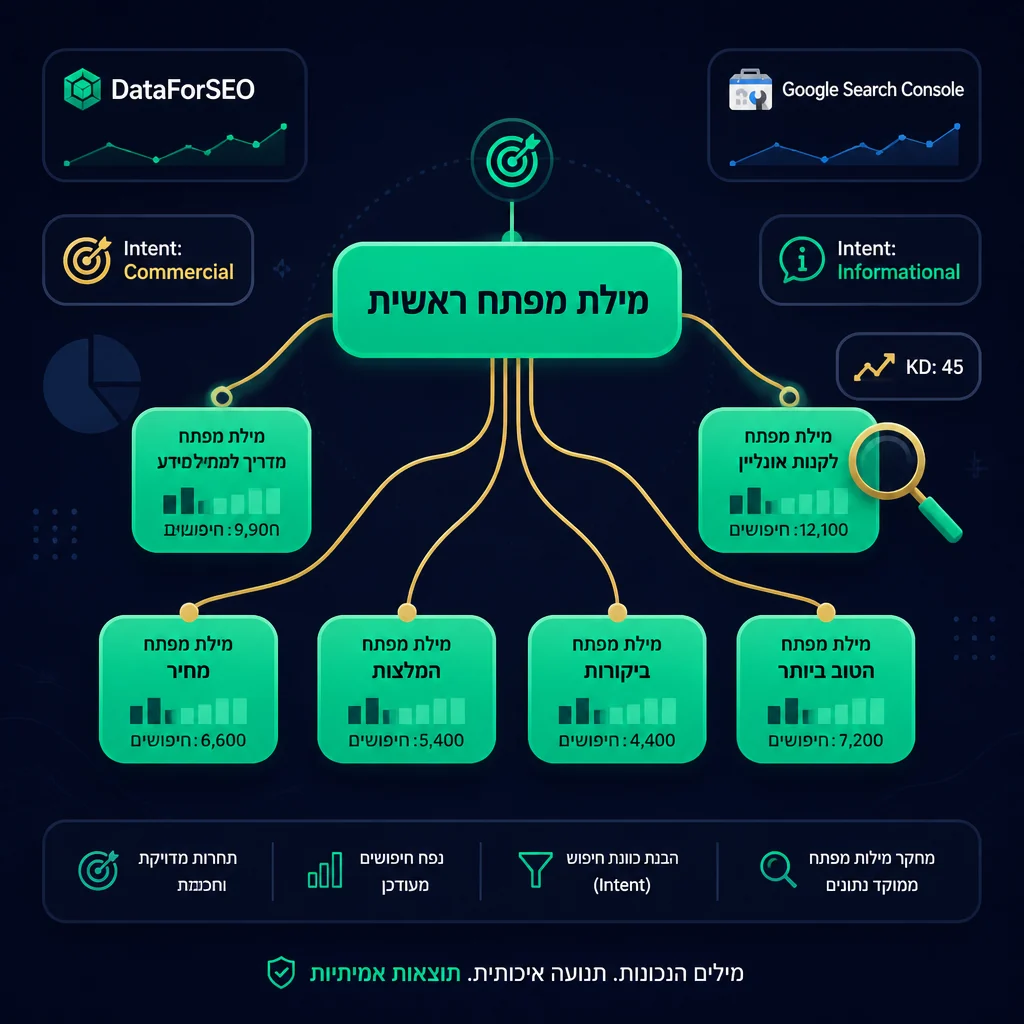
The research starts with a 60-minute call: what you sell, who buys it, what region, what price band. Without that base, every keyword I collect is theoretical — disconnected from the actual business. From the call I leave with a framework, and from there I build a hierarchical map of 200-500 terms in Hebrew (and English where relevant), grouped into topical clusters, with search volume, Keyword Difficulty (KD), search intent, and writing priority on each one. The deliverable includes a 6-12 month content plan.
Three data sources run in parallel: DataForSEO for search volume and KD, Google Search Console for phrases that already get impressions but few clicks (often the quickest long-tail wins, since the page already shows up), and competitor analysis to see where the bigger players are aiming. The intersection of the three gives a list you can work with — not phrases that sound good in theory but have no real volume.
What you receive at the end: a Google Sheet with every phrase, a visual cluster map, and a 45-minute walkthrough call. Each cluster contains a primary phrase plus 5-15 secondary phrases, with a note on which page targets the cluster — an existing page that needs a rework, or a new page that needs to be written. Plus the writing plan for the months ahead, ordered by ROI (search volume × KD × intent), not by personal taste.
Hierarchical map, not a flat Excel
A topic tree with topical clusters, so you cover the niche in depth and every page has a clear role. Not a flat 300-row list with no relationships between the rows.
Data triangulated from three sources
DataForSEO, Google Search Console, and your actual competitors. The intersection of the three produces a workable list, not phrases that sound impressive but have no real volume behind them.
Intent classified for every term
Each phrase tagged informational, commercial, or transactional. Each classification maps to a different page type. Without that step, the page can miss what the searcher wants, however good the phrase research is.
Prioritized writing plan
Not just a list — an actual order of operations for 6-12 months. What gets written in month one, what comes after, and why. Prioritized by ROI, not by which topic feels most interesting to you that week.
How we work
- 1
Business intake call
60-minute call covering product, audience, geographic regions, and competitors. Without this base, the research turns into an academic exercise disconnected from the actual business.
- 2
Raw keyword extraction
Pull from DataForSEO, from Google Search Console if there is an active account, and from competitors. Raw list of 1,500-4,000 phrases in Hebrew (and English where needed).
- 3
Filter and cluster
Filter by minimum volume, remove irrelevant phrases, group the survivors into topical clusters by semantic similarity and search intent.
- 4
Intent classification and priority
Classify each phrase (informational, commercial, transactional), add KD, set cluster priority by expected ROI for your specific domain.
- 5
Delivery and walkthrough call
Google Sheet with 200-500 phrases, visual cluster map, 6-12 month writing plan. Includes a 45-minute walkthrough call so you understand the logic, not just the numbers.
Keyword research pricing — ₪1,800 one-time
One-time, not monthly. Pricing scales with niche scope (up to 200 final phrases, 200-500, 500-800+) and with language mix — Hebrew only or Hebrew + English. Includes the Google Sheet, the visual cluster map, and the 45-minute walkthrough call.
Get a custom quoteOr see all SEO packages →
FAQ
What is the difference between keyword research and a phrase list in Excel?
A phrase list in Excel is raw material, and any keyword tool can export one cheaply. The real work starts after: filtering irrelevant phrases, grouping into clusters by topic similarity, classifying each by search intent, cross-referencing against your competitors and your existing Search Console data, and then building a prioritized writing plan. A flat list does not tell you what to write first or which page should target what; a hierarchical structure does.
How many keywords do I get?
200-500 final phrases typically, grouped into 15-50 topical clusters. The range depends on niche scope — a tight local service gets 200-300 phrases in around 15 clusters, a broad B2B brand gets 400-500 phrases across 30-50 clusters. The scope is decided together during the intake call, not promised on the spot.
Is the research worth doing if I already do SEO?
It is more valuable if you already do SEO, not less. Cross-referencing the phrases that already get impressions in your Search Console against the phrases you have not yet captured often reveals phrases where you already rank on page 2 or 3, and targeted optimization can move some of them up sooner than a new article would. No ranking timeline is guaranteed, but it is work you can start before writing a single new article.
Do you research English keywords too?
Yes. For businesses selling to an international audience, or for businesses where Israelis type the phrase in Latin characters ("SEO" or "WooCommerce" rather than Hebrew transliterations), I build the research in both languages in parallel. The classification is unified and the clusters are tagged by source language, so you know when to write in Hebrew, when in English, and when both versions are needed.
After the research — do you also write the articles?
The research is an independent deliverable. You can take it to any writer or agency. Many clients continue with me on the monthly article package (from ₪950/month), with article priority set by the research. That way every article is written on a verified foundation instead of by feel.
Let us help
Send a message describing what you need and we will reply with a quote and recommended next step within an hour during business hours.
Related
- SEO service · Article writing SEO articles that rank on Google month after month
- SEO service · Technical SEO Technical SEO — the foundation that decides whether conte...
- SEO service · AI Overviews AI Overviews optimization — get cited inside Google's AI ...
- SEO service · Search Console Google Search Console monitoring — see what is working be...
- SEO service · Fact-checking Fact-checking and source citation — the new minimum for E...